English
 Español
 Deutsch
Industry News

(86-579)8507 2566
Welcome to Zhejiang Weiya Cosmetics Co., Ltd.





Welcome to Zhejiang Weiya Cosmetics Co., Ltd.
May 22, 2026
The appeal of a warm, sun-touched complexion is easy to understand — it reads as healthy, vibrant, and alive in a way that flat, unvaried skin tone often does not. The problem is that achieving that look through actual sun exposure involves a trade-off most skincare-aware consumers are no longer willing to accept: cumulative UV damage, accelerated surface aging, and long-term skin health consequences that compound over time. Tanning Face Oil Drops emerged as a category precisely to bridge that gap — offering a way to build a gradual, believable warmth into the skin using cosmetic chemistry rather than UV radiation, and doing so in a form that integrates with an existing skincare routine rather than replacing it.
The case against UV tanning has been built over decades of dermatological research. The short version is that the same process that produces melanin — the skin's natural defense response to radiation — also triggers cumulative cellular damage that surfaces as premature fine lines, loss of elasticity, uneven pigmentation, and elevated skin cancer risk.
What changed in consumer behavior is not the underlying science, which has been understood for a long time. What changed is the expectation that a tan requires sun exposure at all.
Self-tanning technology, particularly DHA-based formulations, has matured to the point where the results are natural enough that the visible gap between UV-tanned and product-tanned skin is no longer obvious to most observers. That shift in product quality is what made the UV-free glow approach viable as a mainstream skincare routine rather than a specialty workaround.
Self-tanning products have existed in various forms for years. The drops format — a concentrated liquid added to an existing moisturizer, serum, or facial oil — represents a specific evolution in how users interact with tanning chemistry.
The distinction matters for a few reasons:
Concentration control: Drops allow the user to adjust the intensity of the color development by varying how many drops are added to the carrier product. This produces a more gradual, customizable result than a fixed-formulation product applied directly to the skin.
Compatibility with existing routines: Rather than adding a separate tanning step, drops integrate into the product already being used. The moisturizer does not change; the result changes.
Texture and feel: Because the drops are diluted into a carrier, the skin contact experience is that of the carrier product — not a separate tanning lotion with its own texture profile.
Facial-specific formulation: Products designed for face use are typically formulated differently from body products, with ingredient selections suited to thinner, more reactive facial skin.
The active mechanism in most self-tanning drops is DHA — dihydroxyacetone. This is a simple carbohydrate compound that reacts with amino acids in the outer layer of the skin surface through a process called the Maillard reaction, producing brown-toned pigment molecules called melanoidins.
Key points about how this works:
The gradual fade is one of the properties that makes drops-based products well-suited to facial use — the color does not vanish abruptly, and maintenance is a matter of repeating the routine rather than reapplying a heavy product.
The formulation around the active DHA determines much of the product's skin compatibility and overall skin feel. A facial tanning drop that contains only the tanning active and carrier oil is functional but limited. More refined formulations include supporting ingredients that address the skin at the same time as the color is developing.
Ingredients commonly found alongside DHA in facial tanning oil drops:
The ingredient list is where the difference between a functional tanning product and a genuine skincare-integrated product becomes visible.
The quality of the result is heavily influenced by how the product is applied, not just what the product contains. Inconsistent application produces patchy, uneven color. A consistent process produces a natural, gradual effect.
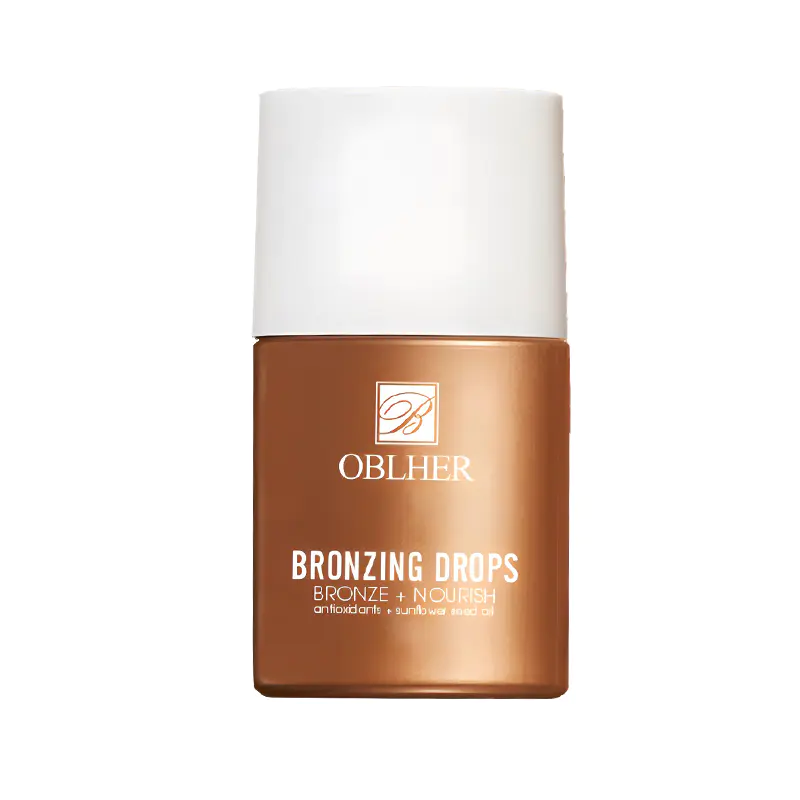
The terms bronzing drops and tanning drops are used loosely and sometimes interchangeably, but they describe products that work through different mechanisms.
Bronzing Drops Body and face products typically contain iron oxides or other pigments that create an immediate color effect on the skin surface. This effect washes off when the skin is cleansed — it is a temporary, makeup-like result rather than a chemical reaction.
Tanning drops, by contrast, produce a color change that persists through cleansing because the reaction has already occurred in the skin cells. The result fades as those cells are shed naturally.
In practical terms:
Understanding the distinction helps users select the product type that actually matches their expectation for the result.
| Product Type | Mechanism | Result Timeline | Durability | Skin Type Suitability | Best Use Scenario |
|---|---|---|---|---|---|
| DHA tanning drops | Chemical reaction with amino acids | Hours to develop | Fades over several days | Broad, though sensitive skin needs lower DHA concentration | Gradual glow maintenance routine |
| Bronzing drops (pigment-based) | Surface pigment deposit | Immediate | Washes off | Broad | Single occasion glow |
| DHA plus erythrulose drops | Dual sugar reaction | Slower, more gradual | Longer fade time | Suited to dry skin types | Sustained, natural-looking color |
| Self-tanning serum | Similar DHA mechanism in serum base | Hours to develop | Fades over several days | Can suit oily skin types better than oil-based drops | Routine integration for oily or combination skin |
| Tinted moisturizer with DHA | Combined immediate and developing color | Partial immediate, developing over hours | Partial durability | Broad | Entry-level routine integration |
For brand developers and OEM buyers evaluating formulation options, this comparison illustrates that the category has real differentiation across mechanisms, timelines, and skin type suitability — not just marketing positioning.
DHA is generally considered well-tolerated, but facial skin is thinner and more reactive than body skin, and formulations designed for the face need to reflect that.
Considerations for sensitive skin:
Sensitive skin does not exclude the use of tanning drops, but it does require more careful product and application selection.
The UV-free glow category has seen sustained growth as consumer awareness of UV damage consequences has increased and as the quality of self-tanning formulations has improved enough to remove the traditional barriers to adoption.
The direction of product development reflects several converging trends:
For OEM and brand development teams, these trends define where the market's expectations are moving.
The path to a natural sun-kissed glow that does not compromise skin health is now well-established as a product category with real science behind it. The mechanism works, the formulations have matured, and the routine integration that drops-format products enable has removed the friction that once made self-tanning products feel like a specialty niche rather than a mainstream skincare step. For brands and private label buyers looking to develop or source Tanning Face Oil Drops and related glow products, the formulation decisions — DHA concentration, supporting ingredients, skin type targeting, fragrance profile — are where differentiation is built. Zhejiang Weiya Cosmetics Co., Ltd. develops and manufactures facial tanning and glow formulations for OEM and ODM clients, with formulation experience across DHA-based drops, bronzing serums, and skin-oil bases suited to both face and body applications. Their team works with clients from initial formulation brief through to finished product development, and can advise on ingredient selection, concentration calibration, and packaging formats suited to the UV-free glow category. Reaching out with a product concept or an existing formulation you want to improve is a practical starting point for developing a finished product that matches both the aesthetic expectation and the skincare standard this category now demands.
Your email address will not be published. Required fields are marked *